Introduction
Ball valves are one of the most widely used valve types in industrial pipeline systems. Known for their reliability, fast operation, and excellent sealing performance, they are essential in industries such as oil & gas, petrochemical, power generation, and water treatment.
However, selecting the wrong ball valve can lead to leakage, pressure loss, or even system failure. This guide will help you understand ball valve types, working principles, and how to choose the right one for your application.
What is a Ball Valve
A ball valve is a quarter-turn valve that uses a hollow, perforated ball to control fluid flow. When the valve handle is turned 90 degrees, the ball rotates to either allow or block the flow.
This simple mechanism provides fast shut-off and reliable sealing, making ball valves ideal for critical industrial applications.
How Does a Ball Valve Work
The working principle of a ball valve is based on rotation. When the handle is aligned with the pipeline, the valve is open. When rotated 90 degrees, the flow is completely shut off.
This design ensures minimal leakage and quick response, especially in emergency shut-off situations.
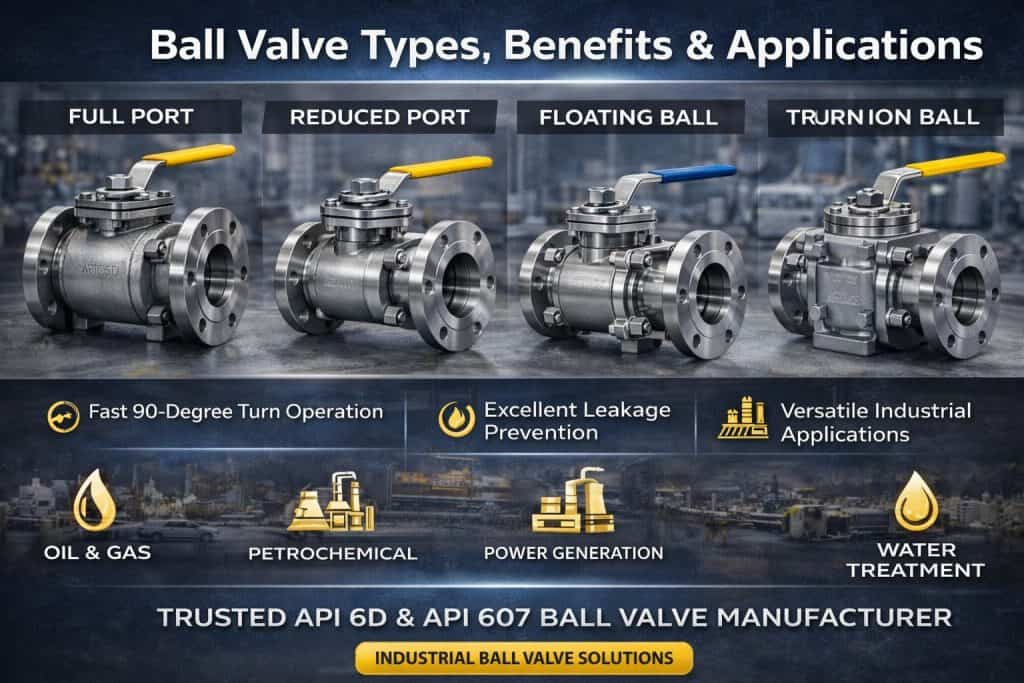
Main Types of Ball Valves
1. Floating Ball Valve
The floating ball valve is the most common type. The ball is supported by seats and moves slightly under pressure to ensure tight sealing.
2. Trunnion Ball Valve
Designed for high-pressure applications, trunnion-mounted ball valves provide better stability and reduced operating torque.
3. Full Port Ball Valve
Full port valves allow unrestricted flow, reducing pressure drop and improving efficiency in pipeline systems.
4. Reduced Port Ball Valve
Reduced port valves are more compact and cost-effective but may cause slight pressure loss.
5. Top Entry Ball Valve
Top entry designs allow easy maintenance without removing the valve from the pipeline.
6. Three-Way Ball Valve
Used for flow diversion or mixing applications, commonly found in chemical and process industries.
Key Advantages of Ball Valves
- Fast 90-degree operation
- Excellent sealing performance
- Low maintenance requirements
- Long service life
- Suitable for high-pressure systems
Common Customer Pain Points
1. Leakage Issues
Low-quality ball valves may fail to provide proper sealing, especially under high pressure or temperature conditions.
2. High Torque Operation
Improper valve design can make operation difficult, especially in large-size valves.
3. Incorrect Valve Selection
Choosing between floating and trunnion types without understanding application requirements can lead to performance issues.
How to Choose the Right Ball Valve
- Consider pressure and temperature requirements
- Select the correct material (WCB, Stainless Steel, etc.)
- Choose full port for maximum flow efficiency
- Use trunnion type for high-pressure applications
Explore our industrial ball valve solutions for different applications and specifications.
Industrial Applications
- Oil & Gas: Pipeline shut-off and control
- Petrochemical: Chemical flow systems
- Power Plants: High-pressure steam systems
- Water Treatment: Flow regulation and isolation
Ball Valve vs Gate Valve
While ball valves provide fast operation and tight sealing, gate valves are better suited for full flow applications with minimal pressure drop.
Read our detailed gate valve vs ball valve comparison to learn more.
Conclusion
Ball valves are essential components in modern industrial systems. Understanding their types and applications helps engineers and buyers make better decisions, improving system efficiency and reducing operational risks.
FAQ
What is a ball valve used for?
Ball valves are used for flow control and shut-off in industrial pipeline systems.
Which is better, ball valve or gate valve?
It depends on the application. Ball valves are better for sealing and fast operation, while gate valves are better for full flow.
What is the difference between floating and trunnion ball valve?
Floating ball valves rely on seat pressure, while trunnion valves use mechanical support for high-pressure applications.