Introduction
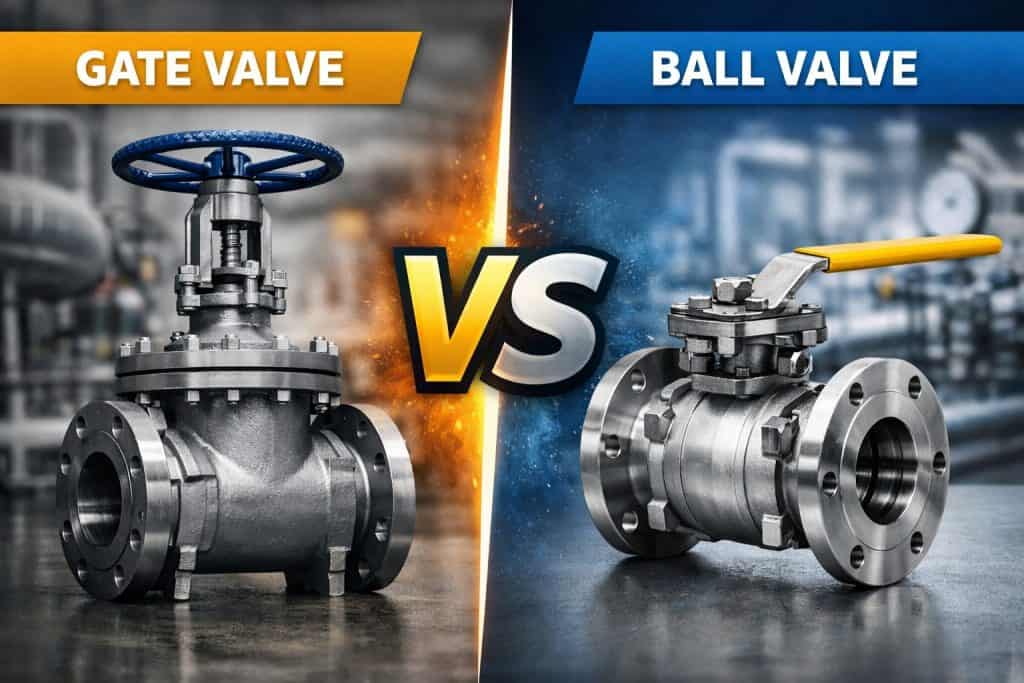
Understanding the difference between gate valve vs ball valve is essential for industrial valve selection.
Choosing between a gate valve and a ball valve is one of the most common challenges faced by engineers and procurement teams. Selecting the wrong valve type can lead to leakage, pressure loss, frequent maintenance, and even system failure.
This gate valve vs ball valve comparison helps engineers choose the right valve for their application.
In industrial applications such as oil & gas, petrochemical plants, and pipeline systems, the decision between gate valves and ball valves directly affects safety, efficiency, and long-term operating costs.
This guide provides a clear comparison between gate valves and ball valves, helping you select the right solution for your project.
What is a Gate Valve
A gate valve is designed for full open or full close operation. It uses a gate (or wedge) that moves vertically to allow or block flow.
When fully open, gate valves provide minimal flow resistance, making them ideal for large pipeline systems where pressure drop must be minimized.
- Best for on/off service
- Low pressure drop
- Suitable for large diameter pipelines
What is a Ball Valve
A ball valve uses a rotating ball with a hole through the center to control flow. It provides quick shut-off and excellent sealing performance.
- Quarter-turn operation (fast open/close)
- Excellent sealing performance
- Suitable for frequent operation
Key Differences Between Gate Valve and Ball Valve
| Feature | Gate Valve | Ball Valve |
|---|---|---|
| Operation | Slow (multi-turn) | Fast (quarter-turn) |
| Sealing | Moderate | Excellent |
| Pressure Drop | Very Low | Low |
| Maintenance | Higher | Lower |
| Cost | Lower (large sizes) | Higher |
Common Pain Points in Valve Selection
1. Frequent Leakage Problems
Many systems experience leakage due to improper valve selection. Gate valves may not provide tight sealing under certain conditions, especially when used in applications requiring frequent operation.
2. High Maintenance Costs
Choosing the wrong valve type can lead to wear and tear, increasing maintenance frequency and downtime.
3. Incorrect Valve for Application
Using a gate valve for throttling or a ball valve in unsuitable conditions can reduce efficiency and damage equipment.
How to Choose the Right Valve
Choose Gate Valve When:
- You need full flow with minimal pressure drop
- The valve operates infrequently
- The system requires large diameter valves
Choose Ball Valve When:
- You need fast shut-off
- Tight sealing is critical
- The valve is operated frequently
For pipeline systems, many projects use gate valves for isolation and ball valves for control and quick shut-off.
Learn more about our industrial gate valve solutions and ball valve products for different applications.
Industrial Applications Comparison
- Oil & Gas Pipelines: Gate valves for isolation, ball valves for control
- Petrochemical Plants: Ball valves preferred for sealing performance
- Power Plants: Gate valves used in high-pressure systems
- Water Systems: Both types used depending on function
Cost vs Performance Consideration
While gate valves are generally more cost-effective for large sizes, ball valves offer better long-term performance with lower maintenance.
Choosing between initial cost and lifecycle cost is a key decision factor.
Conclusion
There is no single “best” valve. The right choice depends on your application requirements, including pressure, temperature, operation frequency, and sealing needs.
Understanding the differences between gate valves and ball valves helps you make a more informed decision, reducing risks and improving system efficiency.
Frequently Asked Questions (FAQ)
Which valve is better for shut-off?
Ball valves are better for quick and tight shut-off applications.
Are gate valves cheaper than ball valves?
Gate valves are generally more cost-effective for large sizes.
Can gate valves be used for throttling?
No, gate valves are not suitable for flow control or throttling.
Which valve requires less maintenance?
Ball valves usually require less maintenance due to better sealing design.